- At the very beginning of the Bible, God reveals Himself as the intelligent Creator of intelligent creatures (mankind). From our own observation, we know that intelligent beings communicate with one another. Therefore, it is reasonable to expect that God has set out to communicate with us.
- The Bible indicates that He has done so, by two methods:
- Through nature (General Revelation) - His creation declares certain things about God, without using words (Psa 19:1-3; Rom 1:19-20). Man has largely rejected God's revelation in nature. By doing so, they reveal themselves to be less than wise. Rom 1:21-23
- Beyond nature (supernaturally) - Through the words of human language (Specific Revelation), as recorded in His written Word, God declares far more than we could understand by observing creation alone (Psa 19:7-14). Phrases like "Thus saith the Lord...", "God says..." or the equivalent, occur more than 2500 times in the OT. The NT also claims to be God's Word. For example: John 17:14, 2Tim 3:16, 1Joh 5:9-12 (Cp. Joh 1:18)
- God has spoken to us by means of a progressive revelation. Just as a school teacher cannot cover a year's material in the first lesson, God gave His Word a little at a time, over the course of centuries. Progressive revelation does not imply that new books are being added to the Bible, today. The final chapter of the Bible warns against additions (Rev 22:18,19). Some cults regard other books as having scriptural authority. But invariably, these books fail the tests of canonicity (see chapt. 1).
- Has God revealed all that can revealed? No. There is much more that He will reveal, when Christ returns to earth (1Joh 3:2; 1Cor 13:12). The last book of the Bible gives us a foreview of the further 'Revelation of Jesus Christ,' at the end of the age. Until then, the Lord has "given unto us all things that pertain unto life and godliness" in the knowledge that we have concerning Him, through His Word, in this present age. (2Pet 1:3)
- From eternity past, to eternity future, God's Word is forever settled in heaven (Psalm 119:89). Long before the first man was created, before God spoke to Adam, and before He caused a word of Scripture to be written, His purposes were established. Before man fell into sin, God's plan of salvation was in place (1Pet 1:18-20; Rev 13:8b). Long after He has put the present creation aside, His Word will endure, and His revelation will continue (Heb 1:10-12; 1Cor 13:12).
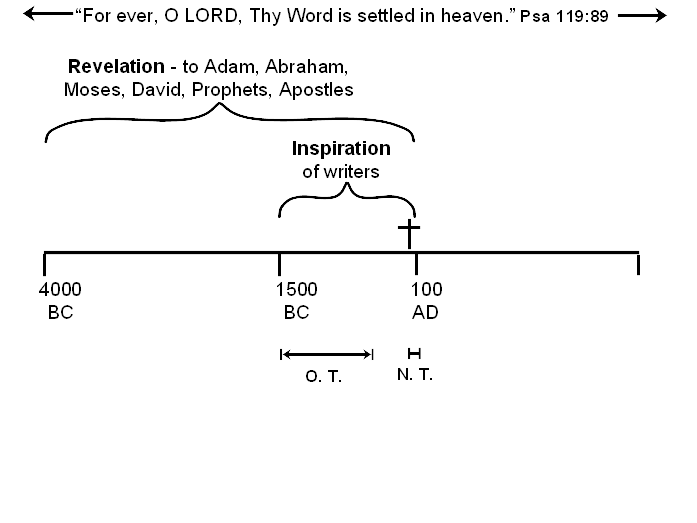
- In 2Tim 3:16 we read that "all scripture is given by inspiration of God..." The Greek word translated "inspiration" is "theopneustos" which literally means (theo) "God"-"breathed" (pneustos). Since Scripture comes out from God, it expresses His thoughts (not merely the thoughts of human writers). Furthermore, since Scripture is God-breathed it is somehow alive and infused with power. (cp. Gen 2:7; Heb 4:12)
- 2Pet 1:20,21 says that "...holy men of God spoke as they were moved by the Holy Spirit..." The writers were "holy men" in the sense that they were set apart for God's purposes. But the writers considered themselves sinners and unworthy to be used by God. Moses and David faithfully recorded their own failures. But God supplied their lack. He moved on their hearts by His Spirit in such a way that they said what He wanted said. God expressed Himself even through their weaknesses and emotional highs & lows. Compare Ex 4:10-15; Jer 1:4-9; 20:9
- As shown in the diagram above, there were two periods of Inspiration. As directed by the Holy Spirit, Moses recorded the things which had been revealed in prior years (eg., to Adam, Noah, Abraham, Isaac, Jacob...). Subsequent prophets wrote as the Holy Spirit moved them. The OT was completed during the ministry of Ezra. Following that, there was a 400 year period of silence, when there was no new word from the Lord (Micah 3:5-7; Amos 8:11,12). This silence was broken by the burst of Light at the first coming of Christ (Isa 9:1-2,6-7; Mat 4:12-17). Jesus Himself did not write a page of scripture. However, the NT was completed within 60 years following the Lord's death, resurrection and ascension, as the Holy Spirit moved the apostles to write, as Jesus had foretold (John 16:12-15).
Jesus and the apostles attributed true authorship of Scripture to the Holy Spirit, rather than to the human writers. See: Mark 12:36; Acts 1:16; 4:24,25; Heb 3:7; 10:15-16- From a study of what the Bible says about itself, we understand that inspiration is Verbal (the words), Plenary (the whole), and Infallible (without error).
- "Verbal" inspiration means that every word is exactly where & what God wants it to be.
- Some think that God inspired just the thoughts and concepts. But we need to remember that successful communication of thoughts and concepts requires words. Choose the wrong words and your thoughts may be misunderstood.
- By the way, Verbal inspiration does not require that God dictated His words to men. Sometimes, He did (eg. the Ten Commandments, Ex 20:1). But usually, as we observed earlier, He used men in their weakness and diversity. Some well educated writers used very proper classical language, while others, like Peter the fisherman, seemed to struggle with grammar. If God had dictated, we would expect His literary style to be constant. Instead, God in His infinite wisdom & power, spoke through many styles, yet with exactly the right words.
For example:- Jesus said that God's Word is accurate down to the smallest letter of the Hebrew alphabet (jot), and even to the smallest part of a letter (tittle). Mat 5:18
- A proper understanding of a passage often hinges on a single word, its tense or its number (singular or plural). Examples: "am" not "was" Mat 22:32, "Lord" Mat 22:41-46, "seed" not "seeds" Gal 3:16
- The OT prophets faithfully recorded the things which God had revealed to them, even though they did not fully understand His message. They wrote of Messiah's suffering, and death (Isa 53, Psa 22). They also wrote of Messiah's eternal Kingdom (Isa 11, Psa 45). They could not comprehend how these contradictory concepts could both be true. But they believed that God's words were true, though His thoughts were beyond theirs. They made no attempt to edit the message to resolve the conflicts that were beyond their understanding. (1Pet 1:10-12)
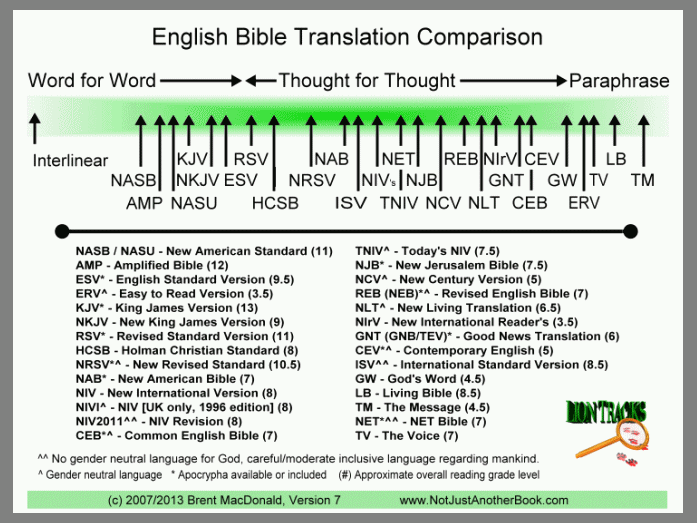
- Verbal inspiration applies to the words as originally given, through the pens of the writers "in old time" (2Pet 1:21). The OT was written in Hebrew (and some Aramaic). The NT was written in Greek. There is always something lost in translation into another language. Often, there are shades of meaning to words or idioms (figurative expressions) in the original language which have no equivalent in the language of translation. For this reason, we cannot say that a particular English translation is "inspired." However, there are differences between translations. Some are more "literal" than others, and attempt to preserve the original word order & idioms. Others tend to paraphrase (or restate) the thought in the idioms of the readers. Where translations distort the message or differ from one another, a study of the Hebrew or Greek text often provides clarification of the intended meaning.
- There are two basic methods of translation:
- Formal Equivalency - often referred to as "Literal" translation, attempts to translate 'word for word,' with relatively minor adjustments for grammatic differences between languages.
- Dynamic Equivalency - attempts to provide a more "Natural" reading in the target language, by transfering 'thought for thought.' The idea is to convey the meaning and purpose (as intended in the source culture), by making textual adjustments to improve understanding in the target culture.
- Here are a few examples of the differences between these translation methods:
- Example A:
- Source (Pennsylvania Dutch): 'Throw the cow over the fence some hay.'
[Note that the Germanic word order, above, is easily misunderstood by an English reader.]- Formal Equivalency - 'Throw some hay over the fence for the cow.'
[Here, the translator has faithfully brought the words from the source language, with adjustments to the grammar of the target language. For better understanding, the word 'for' was inserted and italicized to show that it was an insertion. The KJV and some other 'literal' English versions italicize inserted words for this purpose.] - Dynamic Equivalency - 'Feed some hay to the cow, on the other side of the fence.'
[Readers who are unfamiliar with farming might not understand the reason for throwing hay at cows. Therefore, the translators have changed the verb 'throw' to 'feed' in order to make the purpose clear to the target audience. This can be helpful. However, it may be a source of confusion for the student, who attempts to study the underlying words in the source language (eg., using a concordance of the Greek or Hebrew): How does 'feed' correspond to 'throw'?] - Excessive Dynamic Equivalency (Paraphrase) - 'Cows get hungry, just like people do, so feed them.'
[In some cases, the 'thought for thought' translator takes liberties to express his own viewpoint or agenda, which may go far beyond the intended meaning of the original. In this example, a simple instruction (to feed an individual cow) has become a statement on animal rights, through the use of the plural (cows), and through the symbolic interpretation of the 'fence' as an unnecessary philosophical barrier (separating men and animals) which must be overcome. Obviously, such changes to the meaning can be dangerously misleading. God's thoughts are above our thoughts. We ought not to distort His thoughts by imposing ours upon His Words.]
- Formal Equivalency - 'Throw some hay over the fence for the cow.'
- Example B:
- Source (Romans 16:16):
- Formal Equivalency (KJV) - 'Greet one another with an holy kiss.'
- Dynamic Equivalency (Philips) - 'Give one another a hearty handshake all around.'
[The first reading follows the Greek text closely. However, the second reading is in keeping with the culturally accepted practices in the American church. Although we may prefer the more literal reading, we do not follow the practice of the first century church in this area. Yet, if the reader takes time to learn a little about the culture of NT times, the literal reading is perfectly fine, without adjustment.]
- Example C:
- Source (Psalm 1:1):
- Formal Equivalency (KJV) -
'Blessed is the man that walketh not in the counsel of the ungodly,
nor standeth in the way of sinners,
nor sitteth in the seat of the scornful.' - Excessive Dynamic Equivalency, Paraphrase (the Message) -
'God must really like you --
[Here, the paraphraser has taken liberties which change a solemn warning into flippant sounding congratulatory remarks. The use of slang conveys a tone of disrespect, which is not appropriate to the Word of God. This is only one minor example of the way 'The Message' distorts the message intended by God. Sometimes the distortion is even more severe.]
you don't hang out at Sin Saloon,
you don't slink along Dead-End Road,
you don't go to Smart-Mouth College.'
- Formal Equivalency (KJV) -
- While all English translations use some degree of Dynamic Equivalency, those that lean toward Formal Equivalency are more faithful to 'the words' written under verbal inspiration.
-
- "Plenary" inspiration means that the whole Bible is God's Word ("all Scripture is given by inspiration of God", 2Tim 3:16).
- In contrast, some people say that the Bible merely "contains" God's Word. Saying this, requires that we consider ourselves superior to the Book, because we become judges of what is or is not of God. Who are we to judge God's Word? It is God's Word that judges us (Joh 12:48). We are on dangerous ground when we start to edit the Bible. See Isa 55:8,9; Rev 22:18,19.
- However, plenary inspiration does not mean that every voice in the Bible is God's voice. The Bible also records the words and actions of Satan and of wicked men. God does not endorse their ways, but neither does He hide them. He accurately records these things because He wants us to see the difference between the kingdoms of darkness and of Light.
- "Infallible" inspiration means that the Bible is accurate and true.
- Faith in the Bible cannot be called 'blind faith,' because there is overwhelming internal and external evidence that the Bible is true. These evidences will become increasingly clear to the believer who studies God's Word, as he grows in his understanding. Internal evidence involves the consistent agreement and explanation of any passage within the Bible by other passages which touch the same subject. External evidence involves the confirmation of the Bible's testimony, by secular sources outside of the Bible. By these evidences, it is evident that:
- The Bible is historically accurate. The Bible's historical accuracy has been verified and demonstrated repeatedly by archaeological discoveries. [Example: Skeptics used to criticise the Bible's mention of the Hittite nation as a fabrication (Gen 15:20; 2King 7:6), because this nation was unknown in secular history. However, in the early 1900's, monuments and documents were found in Egypt and in Syria, which clearly identified this nation as a prominent power, in the region, now known as Turkey. Their prominence peaked in two periods (2000-1800 BC and 1400-1200 BC), corresponding to the biblical narrative.]
- The Bible is scientifically accurate. Skeptics have often seen conflicts between the Bible and natural science. However, where the Bible speaks on such matters, it has stood the test of time, while contradictory scientific theories have come and gone. It stands to reason that the One who created all things, will speak with greater comprehension, of His creation, than His creatures. [Example: In ancient times men thought the world rested on the shoulders of Atlas, or on the backs of great elephants. But modern science understands what God's Word said all along, even in its oldest book (Job 26:7).
- The Bible is prophetically accurate. The Bible, unlike any other human literature, speaks accurately concerning the future. Approximately one third of the Bible consists of prophecy about things which were yet future, at the time of writing. About half of those prophetic statements have already been fulfilled. We will look at some of them in future chapters. Fulfilled prophecy is one of the evidences of the veracity of God's Word. (Isa 45:20-22; Isa 46:9,10)
- God's promises, whether of judgment or of blessing, will be fulfilled down to the smallest detail. (Mat 5:18; Num 23:19; Psa 119:89)
Jesus Christ gave witness to the inspiration of Scripture. When His own disciples were slow to believe it, He reproved them, calling them "fools." (Luk 24:17-27)- Early in the twentieth century, in response to a growing tide of skeptical theologians,
Bible believing pastors identified Five Fundamentals of Biblical Christianity:- The Inerrancy of the Autograph.
- The Virgin Birth of Christ (or, The Deity of Christ).
- The Substitionary Atonement of Christ.
- The Bodily Resurrection of Christ.
- The Historic Fact of Miracles (or, The Second Coming of Christ).
-
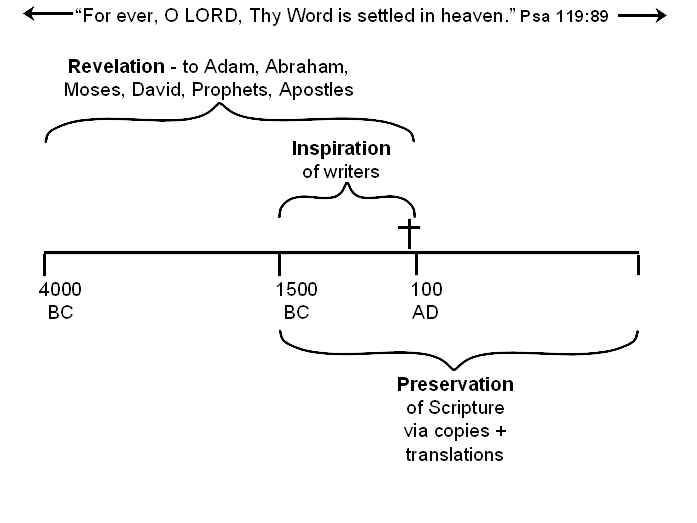
- Preservation- God has protected His Word...
- from His enemies- Many have tried unsuccessfully to destroy the Bible. (eg. Jer 36:20-28)
- from error (ie., distortion; 'Inerrancy' applies only to the autographs.)-
Often men have imagined that the Bible has become corrupted by countless copying errors over the centuries. But this is not the case. The Hebrew scribes took their work of hand copying the Scriptures very seriously. They devised methods to ensure accuracy. For example, they identified the middle letter on each page, counting the letters from the start and also from the end of the page. If the result varied from a known good copy, the page was discarded.
- Preservation- God has protected His Word...
-
- Textual accuracy has also been confirmed by a multitude of ancient manuscripts {'manu'= by hand; 'script'= written}. At the beginning of the twentieth century, the oldest known copies of the OT were dated from 895 AD. But the Dead Sea Scrolls (discovered in 1947), included OT copies dated from 150 BC. These ancient texts were virtually identical to the later copies.
- The NT is supported by ancient copies in far greater abundance and better condition than any other ancient literature. There are more than 5600 NT manuscripts, 9000 portions and fragments, and 86,000 quotes by early church leaders. Compare the documentation for other literature from the same era:
Document Name Number of Manuscripts Date of Oldest Caesar, Gallic Wars 10 900 AD Livy, History of Rome 20 400 AD Thucydide, History 8 900 AD Herodotus, History 8 900 AD The New Testament 14,000 + 125 AD- As noted, in the chart above, there are only ten extant copies of Julius Caesar's "Gallic Wars." We would think that the writings of a world ruler and a military conqueror of distant lands would have been afforded great attention by the world's scholars. Yet, very few copies remain. The text of those extant copies disagree by 57% between one another. In contrast, the New Testament is the account of the life and ministry of a peasant, who was born in obscurity and who died as a criminal. His birthplace and place of death were separated by only ten miles. We would expect His story to be lost and forgotten.
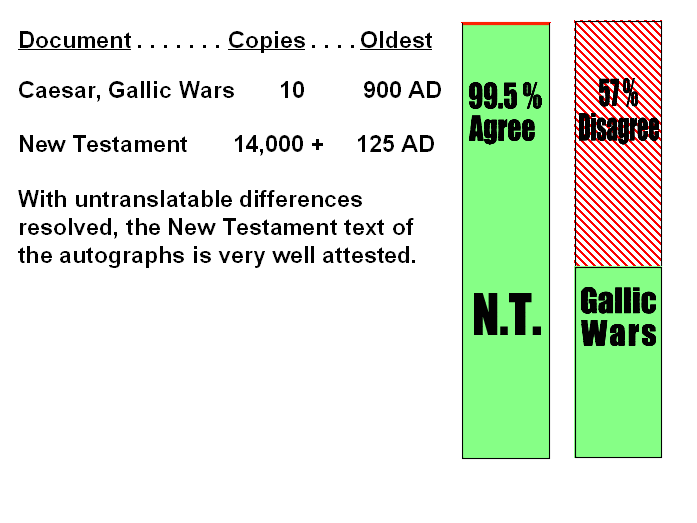 Yet, it has been preserved in overwhelming volume through thousands of manuscripts, distributed across northern Africa, Asia Minor and Europe. Between all of those manuscripts (including some which omit entire passages), there is only 7% disagreement. Most of these differences consist of spelling errors and minor word order changes, which have no translatable effect upon the text. Amazingly, none of the differences between manuscripts distort any doctrines of the Faith. When the minor variations are excluded, there is less than 1.5% disagreement between the combined manuscripts. By comparison of the witness of the various manuscripts, this disagreement can be resolved to discern the text of the original autographs with amazing certainty.
- The second best preserved piece of ancient literature is Homer's "Iliad," which was written in 900 BC. There are 643 known copies, the oldest of which is dated 500 years later than the original (around 400 BC). Of the 15,600 lines in the "Iliad," 764 are in question (about 5%). In comparison, only 40 lines of the 20,000 lines in the NT are in question (less than 0.25%, ie., one quarter of one percent).
- By the multitude of existing copies, the Bible's original text is well established. There is no need to identify a perfect line of transmission. There is no evidence that such a line exists. In fact, due to the nature of hand copied manuscripts, no two manuscripts are exactly alike. If the sentences which open this paragraph are true, how can they be reconciled with Mat 5:18? It would seem that Unless we can find a perfect manuscript line, the 'jots and tittles' have been corrupted, contrary to God's Word. But read the verse again. Did Jesus promise perfect preservation of the written page? No. He spoke of the perfect completion of God's purposes: "till all be fulfilled."
- Yet, God has preserved His written Word, in a way that demonstrates His power and His involvement in the affairs of men. He has used the weakness and infirmities of a multitude of fallible human beings to transmit His Word down through the centuries (Psa 68:11 with 2Cor 12:9). In His wisdom, God has determined that "in the mouth of two or three witnesses, shall every word be established." (2Cor 13:1; Mat 18:16; Deu 19:15). In the case of the NT, there are thousands of witnesses.
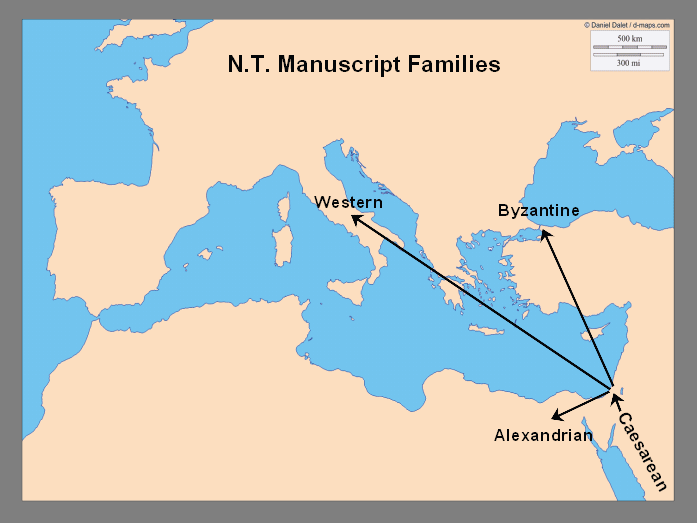
- There are four 'families' of NT manuscripts. Each is named for the area in which most of the similar texts were found. The two major families are as shown below:
Family Name Where Found? Number of MSS Oldest Alexandrian Egypt 30 125 AD Byzantine (Majority) Turkey 5000 + 500 AD- The Alexandrian family (consisting of about 30 manuscripts) includes two major manuscripts, which are much older than the manuscripts in the Majority line. There are many more wording variations between this family of manuscripts and the Majority line. Because of their greater age, some scholars assumed that the Alexandrian manuscripts must be closer to the originals and therefore more accurate. Certain scholars (notably Westcott and Hort) developed composite Greek texts which combined what the scholars felt were the best readings from both manuscript families, often giving greater weight to the older manuscripts.
- However, other scholars are somewhat suspicious of the Alexandrian manuscripts. A few of the early church fathers, wrote that certain men in Alexandria, who held heretical views, were rewriting certain passages to fit their views. It should be noted, however, that the differences between the Alexandrian and Byzantine texts are relatively minor. (Although, some are noticeable, especially where verses are omitted entirely.) If the text was purposely altered to accommodate a heresy, the editors did not do a thorough job. Whereas a verse may have been deleted or altered, the surrounding context usually continues to support the doctrinal position presented by that verse (as found in the Byzantine text).
- The greater age of the earliest copies in the Alexandrian line may be partially explained by the dry environment of Egypt, compared to the moist environment of Constantinople (Byzantium). Additionally, because of known textual errors (eg., omitted verses), it is possible that these manuscripts were rejected for regular use, and were set aside in storage. Without seeing usage, these manuscripts would naturally last longer. Some of the modern scholars, who assembled the composite Greek texts, may have favored the Alexandrian text where it differs from the Byzantine, not only because of manuscript age, but also because of personal bias toward liberal or skeptical views (as expressed elsewhere in their scholarly writings).
- However, as discussed earlier, the differences between the manuscript families are actually minor and doctrinally insignificant. Each of the manuscript copies and the translations, which were made from them, were God's Word to the people in various regions at various times. Yet, none of the copies or translations were perfect reproductions of the original autographs. How can this be? Manuscript families are a lot like human families. The human race, which began with a common set of parents, has been scattered into all corners of the earth. There are very noticeable differences between the people from various regions. Each ethnicity has distinguishing physical, cultural and linguistic characteristics. Yet, they are all "of one blood" (Acts 17:26,27). They are all human. All bear the image of God (but imperfectly). All are in need of the one Way of salvation. In the same way, in spite of the differences between manuscript families, each manuscript is God's Word, as each proclaims Christ as the Savior for whosoever will believe.
- The manuscripts which have survived to the present day, witness together to the text of the autographs. Even the Alexandrian texts, which some reject as being more flawed, testify by reason of their greater age, to the early completion of the NT, and therefore, to apostolic authorship.
- God has been pleased to use the various manuscripts and translations, although none of them perfectly duplicated the autographs. When Jerome began to translate the Latin Vulgate (c. 300 AD), Augustine protested that there was no need for a new translation of the OT. He argued that the Greek Septuagint was time tested and God blessed. He rightly pointed out that Jesus and the apostles used the Septuagint. Similar arguments have been made to support various translations in more recent years. Of course, subsequent translations could not have been used by the Lord or the apostles. (You may have noticed that where the NT quotes from the OT, the reading is often somewhat different. The difference is usually because the NT writer is quoting from the Septuagint, rather than the Hebrew Masoretic text (eg., compare Psa 40:6 with Heb 10:5). The Holy Spirit incorporated such textual variations, in order to further open our understanding. The Septuagint and the Masoretic texts differ far more widely than the combined differences between all of the NT manuscripts. Yet, the Holy Spirit, the Lord Jesus Christ, and His apostles did not reject one in favor of the other. They regarded both volumes as God's Word.
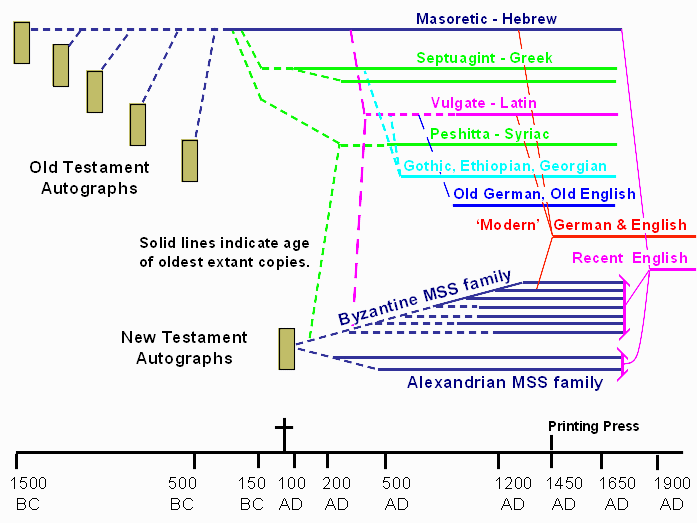
- The Lord has drawn people to salvation through His Word, in whatever form it has gone into the world. Although some people do not think highly of the Latin Vulgate, Martin Luther was born again through reading it, in 1517 AD. The first Bible off the Gutenberg press was in Latin. The invention of the moveable type printing press, greatly reduced the cost of owning a Bible (which previously had been equivalent to the average man's wage for three years). With the reduction in cost, came an increase in demand, for Bible translations in the local language, and also for printed versions of the Hebrew and Greek texts, from which those translations would be made. Notice, in the diagram above, that the production of modern German and English translations coincided with the introduction of modern printing. These modern translations drew from the Hebrew and Greek texts, whereas previous translations into German and English were mostly from the Latin Vulgate. Several newly available printed Hebrew and Greek texts facilitated this process. (At that time, there was a competitive rush, to get the Greek "Textus Receptus," into print. Five, somewhat differing volumes were produced by different publishers, each drawing from whatever manuscripts were available to the editors.)
- But why didn't God preserve the original documents? Perhaps He knew that men would revere the ancient pages as sacred, while missing the significance of their message. (Man's tendency to this kind of error is illustrated by the improper worship of Moses' brass serpent, and its greater significance. Num 21:8,9, 2Kin 18:4, Joh 3:14,15) God cannot bless the worship of paper. He wants us to hear and heed His Word.
- Why didn't God await the invention of the printing press, before committing the NT to paper? In His wisdom, He chose to have it transmitted by hand copying for fourteen centuries. As manuscripts were taken into every corner of the world, and copied over and over again, each copy provided a cross witness against all others. If someone had purposely attempted to alter the text, it would be readily evident by comparison with manuscripts from other times and places. No entity would have the ability to mass produce and distribute an erroneous text to replace copies that were faithful to the original autographs.
- Textual accuracy has also been confirmed by a multitude of ancient manuscripts {'manu'= by hand; 'script'= written}. At the beginning of the twentieth century, the oldest known copies of the OT were dated from 895 AD. But the Dead Sea Scrolls (discovered in 1947), included OT copies dated from 150 BC. These ancient texts were virtually identical to the later copies.
-
- Illumination- God must enable His people to understand His Word.
- Look again at 1Pet 1:10-12. Notice that the prophets, and even the angels, did not fully understand what God was saying as the Scriptures were being written. They were recording God's revelation, yet they understood only what God "revealed" personally to them. Today, believers have the benefit of increased understanding through "the Holy Ghost sent down from heaven."
- Jesus' disciples spent more than three years under His teaching. But it was not until He "opened their understanding" that they began to understand the Scriptures. (Luke 24:44,45)
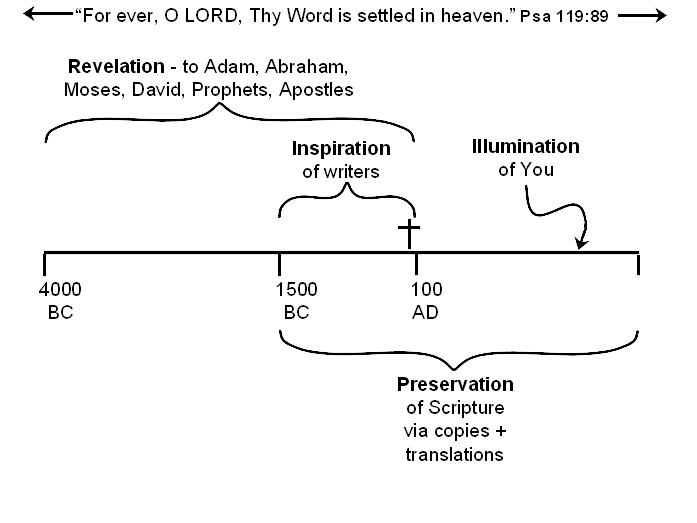 I may appreciate the Bible as literature. I may know many Bible stories. I may respect its moral guidance. But unless God "illumines" (makes His light shine into) my heart, I cannot fully benefit from His Word.
We need to be aware that:- The natural human heart is blind to God's truth. 1Cor 2:14; Joh 16:7-11; Joh 3:3-12
- The regenerate (born again) human heart is hard of hearing. God's children are dependent upon the Holy Spirit to teach them to understand God's Word aright. 1Cor 2:9-13; Joh 16:12-15
- We hinder the Holy Spirit's work by:
- neglect of His Word (eg., Heb 5:11-14),
- carnal living (1Cor 3:1-3),
- failure to pray for opened eyes (Eph 1:15-23), and
- failure to use proper methods of interpretation (2Tim 2:15).
- God's Word is essential for spiritual life. Deu 8:3; Mat 4:4; Jer 15:16; 1Pet 1:23; 2:2,3; Josh 1:8
-
- The Word of God, the Bible, is the final authority for God's people on earth.
- We will discuss this further in Understanding the Bible, lesson 6 - Major Bible Doctrines, in the section shown as "Church Things: Final Authority."